
As the creative industry backs an Open Letter to Government, AMPAL calls on the Australian Government to hold the line on AI, copyright and creator rights
Australia’s music publishers have issued one of their strongest warnings yet over artificial intelligence and copyright, arguing the Federal Government risks trading away the rights of songwriters and composers in a rush to attract AI investment.
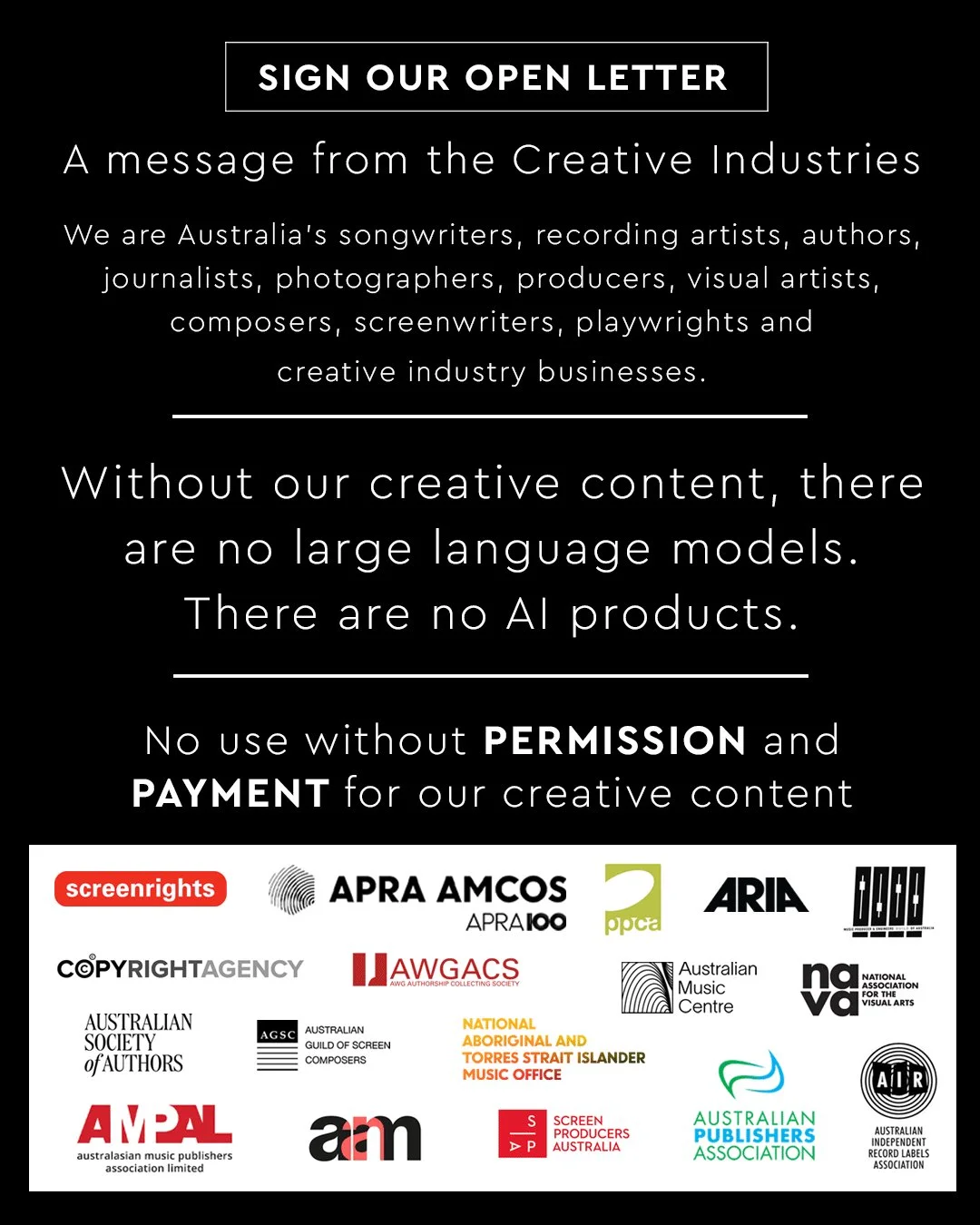
The Australasian Music Publishers’ Association Limited (AMPAL) is backing the creative industries’ Open Letter to Government, which calls on the Australian Government to commit to the future of creativity in this country and reject any weakening of copyright protections for AI companies.
AMPAL is encouraging music publishers, songwriters, composers, music businesses and the wider creative sector to sign the Open Letter and add their voices to the growing call for no use without permission and payment for their creative content.
The Open Letter can be signed here: Open Letter to Government
As creative industries leaders gather at Parliament House this week, AMPAL has called on Canberra to continue to reject any text and data mining exception or copyright carve-out that would allow AI companies to use music without permission.
AMPAL CEO Damian Rinaldi is at Parliament House alongside AMPAL Board Director Art Phillips, joining a broader push from the music and creative industries to keep permission at the centre of Australian copyright law.
AMPAL’s message is clear and simple: AI companies do not need weaker copyright laws to innovate. They need licences.
“If AI companies want to use music, they need permission, they need a licence and they need to pay fairly”, Mr Rinaldi said.
“Licensing is already working. Australia should not weaken copyright to solve a problem the market is already solving.”
AMPAL says that any carve-out for AI companies would undermine the basic licensing framework that governs every other commercial use of music.
Every other commercial user of music is expected to play by the rules. Radio stations, streaming services, advertisers, film producers, television networks, brands and venues all operate within copyright and licensing systems.
AI companies should not be handed a special exemption simply because they are new, powerful or well-funded.
Innovation is not a reason to bypass permission. Scale is not a reason to avoid licensing.
AMPAL Board Director and Co-CEO of Mushroom Music Linda Bosidis said the issue is not solved by a levy, a fund or an after-the-fact payment scheme.
“A levy is not consent. A fund is not permission. A payment does not replace the right to choose.
“This is an existential threat. Songwriters, the human creators at the heart of every song, must retain the right to say yes, the right to negotiate and the right to say no.
“Once permission is removed, creators no longer control their own work, they become a free resource for tech companies and an unpaid input into someone else’s business model.”
AMPAL says Australia has already held the line on AI and copyright and should not now backtrack.
AMPAL Board Director and Managing Director of Kobalt Music Publishing APAC Simon Moor said a text and data mining exception would risk undercutting licensing deals already being developed in Australia and overseas.
“Backtracking on text and data mining would undermine the licences already in place that enable AI innovation, disrupt legitimate licensing negotiations underway in Australia and around the world, short-change Australian creators, and trade away our cultural assets for a fraction of their true value.
“Australia must not become the weakest link.”
AMPAL Board Director and Owner/Director of 101 Music Art Phillips said music should not be treated as raw material for the technology sector.
“Music is not a pile of content waiting to be scraped.
“It is the result of human lives, human stories and human craft.
“Music publishers are custodians of those rights on behalf of creators. AI companies should not get a special carve-out from the rules every other commercial user of music follows: ask first, pay fairly and respect copyright.”
AMPAL Board Director and Managing Director of Sony Music Publishing Australia Damian Trotter said the industry cannot afford to underestimate the stakes.
“I don’t believe there is anything more important, or that poses a greater threat to songwriters, artists and the wider creative industries, than what is happening right now around AI and the proposed evisceration of copyright.
It is inconceivable that this government could even be entertaining the idea of allowing giant technology companies, who fiercely protect their own IP, to ingest the totality of human creativity without consent, attribution or anything approaching fair compensation.
And in return for what? A bunch of giant boxes in our suburbs, drawing astronomical amounts of power, competing with us for drinking water, all while replacing the next generation’s jobs.
This is not simply about pushing back against another new technology. It is an existential threat, and it must be met with the full force of our industry.”
AMPAL says music publishers support innovation, but innovation must be built on permission, licensing and fair value.
The association says the question for Australia is not whether AI will reshape creative industries, but whether the people who wrote the songs, scores and catalogues AI companies want to use will still have the right to say yes, negotiate a fair price, or say no.
AMPAL is calling on all music publishers, songwriters, composers and creative industry supporters to sign the Open Letter to Government and help reinforce the sector’s message:
No use without permission and payment.
Creative work must be licensed, not taken.
AMPAL’s position is clear:
No exceptions. No free pass. License it.
Sign the Open Letter: Open Letter to Government